
Research · Published:
AP approval delegation evidence research
How to document temporary approval delegation without allowing a support role to invent authority or route an invoice to the wrong owner.
Methodology
Research question: what should an AP queue show when an approver is absent? It should show the invoice, the original approval route, the effective delegation record, the dates covered, and the person authorized under the organization’s policy. An absence note or email alone may not be enough. The finance owner must decide what evidence the organization accepts.
Evidence and scope
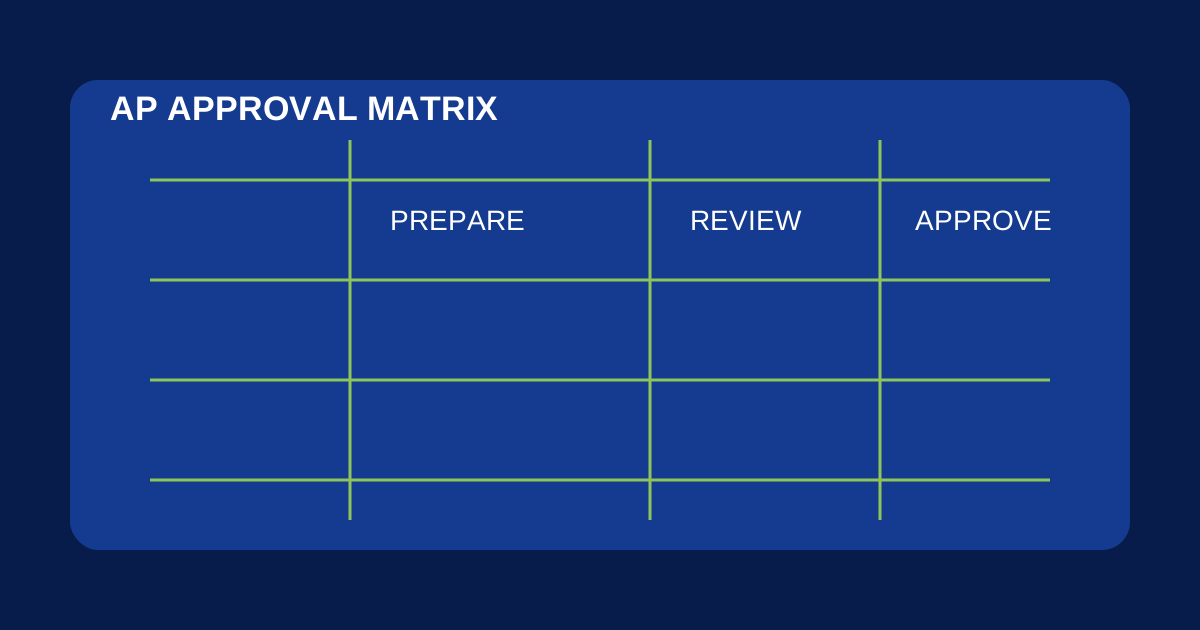
The preparation role can identify a blocked approval, locate the approved delegation source, update a routing status, and ask the responsible owner to confirm a gap. It should not select a replacement because that person is available, approve an invoice on behalf of an absent employee, or change a threshold.
Key Stats
A complete packet separates routing facts from approval authority. Keep the original approver, delegated approver, effective dates, invoice entity, amount, and policy reference in distinct fields. If a delegation covers only an entity or category, record that scope. A broad “out of office” message should not be treated as unlimited permission.
Research-to-practice
GAO’s Green Book describes control activities as actions that address risks. The risk here is an approval that looks ordinary but lacks authority for the date, amount, or entity. The evidence must let a reviewer test those conditions without relying on memory or an informal chat message.
Implementation
Use a short pilot around a known absence period or one approval queue. Sample invoices routed under delegation and compare the route with the approved record. Record unclear scope, expired dates, wrong entity, and missing evidence. The measure is the number and type of review questions, not a claim about delegation performance across organizations.
Key Takeaways
The handoff should flag urgent invoices separately. A due date does not expand a delegate’s authority. If the item needs an exception, the named finance owner must decide whether the organization’s policy permits it and record the decision.
Findings
System permissions should match the delegation. A support worker may prepare and route, while only the delegated or original approver approves. Avoid shared credentials. Preserve the identity of the person who performed each action so later reviewers can distinguish preparation from approval.
Findings
Delegations can interact with vendor, entity, and threshold rules. A queue that only records the approver’s name may miss those limits. Ask one focused question when scope is ambiguous and keep the invoice stopped until an authorized owner answers.
Findings
The study does not define a universal delegation policy. Organizations differ in approval matrices, systems, and legal requirements. The report gives a documentation model for a policy that the organization has already approved.
Findings
Conclusion: approval delegation is safe when the evidence proves scope and time. The support lane can make the route visible and keep the queue moving within those rules. Authority remains with the person the organization has named, not with the person who happens to be monitoring the inbox.
Findings
A closer reading of ap approval delegation evidence research starts with the source record, not the queue label. The label is useful for sorting, but it cannot explain what a reviewer should accept. Write down the field being checked, the record that supplies it, and the condition that sends the item to an owner. This small design choice makes a later sample possible. It also prevents a worker from treating a familiar pattern as permission to make a new decision.
Findings
The proposed test should use real work from the selected AP lane and should state its period. A two-week observation may show where evidence is missing during that period. It cannot tell a finance team what will happen in every quarter, entity, or supplier group. Keep ordinary items and exceptions in separate counts. A single combined count can make a queue look smooth while hiding the cases that consume review time.
Findings
For each item, retain an intake timestamp and a completion or escalation timestamp. Those fields allow a manager to distinguish waiting for evidence from waiting for a decision. They also make the conversation more concrete when a handoff is slow. Do not use elapsed time as a reason to bypass a control. A fast stop with a clear owner is better evidence than a fast approval with no traceable source.
Findings
A reviewer should be able to reproduce the preparation from the approved records. That means the packet needs stable links, the original document, the prepared fields, and a short note when the source does not answer the question. Avoid copying sensitive data into extra files when the system already stores it. If a temporary working file is necessary, the organization should define its retention and removal rule.
Findings
Training examples should include one ordinary case and one case that must stop. The ordinary case teaches the expected output. The stopped case teaches the boundary. Reviewers should explain why each example belongs in its category, because a label without reasoning does not transfer well to a new vendor or entity. The examples should come from the actual scope being tested, not an imagined process.
Findings
The finance owner should review the first sample before the support lane expands. That review can narrow the task, clarify a field, add an escalation route, or approve a limited system permission. Expansion is a decision about evidence and risk, not a reward for moving a large number of records. If the same question appears repeatedly, improve the rule or source access before adding volume.
Findings
This article treats ap approval delegation evidence research as preparation and evidence work. The company’s accounting policy, legal obligations, tax position, bank rules, and approval matrix remain controlling. When those authorities disagree with a convenient queue practice, the queue practice must give way. A research article can frame the question and show what to retain. It cannot grant authority that the organization has not granted.
Findings
The practical conclusion is therefore modest. Build a narrow queue, preserve the source, name the exception owner, and inspect a dated sample. Keep the result tied to the period and scope observed. That method gives a finance manager something useful to review without turning an outsourced preparation lane into an unapproved accounting, payment, or vendor-master function.
Sources
These primary sources support the control principles and evidence boundaries in this report.
FAQs
Are the planning numbers benchmarks?
No. They describe a testable workflow shape and are not promises, market averages, or production targets.
What should an outsourced AP assistant own?
Repeatable preparation, documentation, status tracking, and follow-up within least-privilege access. Named finance owners retain approval and payment decisions.
When should an item be escalated?
When evidence is missing, a request changes payment details, a duplicate or fraud signal appears, or the item falls outside the written rule.