
Philippines AP staffing guide
Create a vendor contact ownership register for AP
Document which supplier contacts are approved for invoices, statements, disputes, and sensitive changes without treating every email sender as trusted.
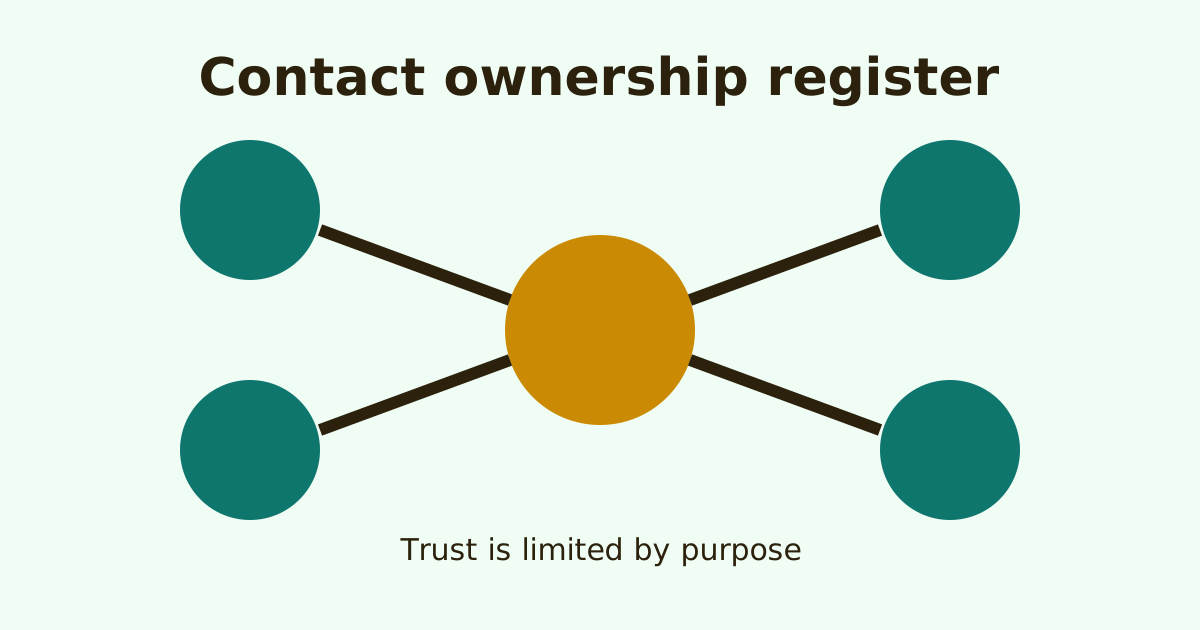
Direct answer
What this role should do
Document which supplier contacts are approved for invoices, statements, disputes, and sensitive changes without treating every email sender as trusted.
A practical AP example
For an AP team receiving messages from several contacts at the same supplier, start with a packet another reviewer can reproduce. Keep the vendor record, contract, onboarding evidence, approved contacts, role and channel, verification result, correspondence, and review history connected by stable identifiers, not by a familiar filename or email subject. A salesperson sends invoices, a shared mailbox sends statements, and a new person requests a bank change. The register clarifies routine channels while the bank request still follows independent verification. Keep the prior value after any authorized correction and link the responder, time, reason, and controlled source. That lineage supports duplicate review, close work, and later audit questions.
The outsourced specialist prepares the evidence and maintains the queue. The vendor-master, purchasing, or supplier relationship owner retains decisions that change accounting, supplier data, access, contractual treatment, or the movement of money. Before work begins, agree on authoritative sources, required fields, stop conditions, permitted system actions, and employee owners. Test those rules with records from the company’s real workflow. Finish the queue entry with a factual status, named next owner, due or review date, and source link. “Done” is not adequate when the underlying business event remains unresolved.
Define contact purpose
Use labeled timestamps for issue, receipt, review, approval, change, and completion. Sequence matters, and a later event must not silently rewrite an earlier source. Separate invoice delivery, statement, dispute, order, tax, security, and sensitive-change contacts by supplier entity. Quality review should include an ordinary item and a difficult exception. A second person should be able to repeat the comparison without an oral explanation from the preparer.
Describe the exception as a comparison: what each source says, which record or amount is affected, what is missing, and which named owner can answer. Record the source location and the observation in separate fields. If sources disagree, keep the item in the exception queue instead of selecting the convenient value. Never fill an evidence gap from a prior invoice simply because the supplier looks familiar. Preserve the received document, flag uncertainty, and ask one answerable question.
Record provenance
Describe the exception as a comparison: what each source says, which record or amount is affected, what is missing, and which named owner can answer. Capture who approved the contact, when, from which controlled source, and how the identity or channel was verified. Never fill an evidence gap from a prior invoice simply because the supplier looks familiar. Preserve the received document, flag uncertainty, and ask one answerable question.
Apply least-privilege access to the work. Preparation rights should cover only the fields and records needed, while authorization and release stay with employees. Put the proposed next action beside the evidence. Missing access, an absent document, and pending authorization are different states and need different owners. Keep the prior value after any authorized correction and link the responder, time, reason, and controlled source. That lineage supports duplicate review, close work, and later audit questions.
Limit trust by task
Apply least-privilege access to the work. Preparation rights should cover only the fields and records needed, while authorization and release stay with employees. An approved statement sender is not automatically authorized to change bank details, legal identity, or commercial terms. Keep the prior value after any authorized correction and link the responder, time, reason, and controlled source. That lineage supports duplicate review, close work, and later audit questions.
Treat new links, contacts, bank details, domains, and urgent instructions as security signals. Verification must use a channel the company already trusts. The handoff should identify the affected record, amount or quantity, deadline, and exact response needed. Link evidence instead of copying an unlabeled value into chat. Finish the queue entry with a factual status, named next owner, due or review date, and source link. “Done” is not adequate when the underlying business event remains unresolved.
Handle shared mailboxes
Treat new links, contacts, bank details, domains, and urgent instructions as security signals. Verification must use a channel the company already trusts. Document ownership, backup route, domain, expected message types, and escalation without relying on a personal relationship. Finish the queue entry with a factual status, named next owner, due or review date, and source link. “Done” is not adequate when the underlying business event remains unresolved.
For an AP team receiving messages from several contacts at the same supplier, start with a packet another reviewer can reproduce. Keep the vendor record, contract, onboarding evidence, approved contacts, role and channel, verification result, correspondence, and review history connected by stable identifiers, not by a familiar filename or email subject. Name who can authorize the next move. Until that response arrives, preserve the last confirmed state and prevent downstream work from implying approval. Quality review should include an ordinary item and a difficult exception. A second person should be able to repeat the comparison without an oral explanation from the preparer.
Review changes independently
For an AP team receiving messages from several contacts at the same supplier, start with a packet another reviewer can reproduce. Keep the vendor record, contract, onboarding evidence, approved contacts, role and channel, verification result, correspondence, and review history connected by stable identifiers, not by a familiar filename or email subject. Use a known channel when contacts, domains, phone numbers, portals, or responsibilities change. Quality review should include an ordinary item and a difficult exception. A second person should be able to repeat the comparison without an oral explanation from the preparer.
The outsourced specialist prepares the evidence and maintains the queue. The vendor-master, purchasing, or supplier relationship owner retains decisions that change accounting, supplier data, access, contractual treatment, or the movement of money. Use a status that describes the actual stop. Preparation can be complete while the invoice, supplier record, or payment remains unresolved. Never fill an evidence gap from a prior invoice simply because the supplier looks familiar. Preserve the received document, flag uncertainty, and ask one answerable question.
Expire stale entries
The outsourced specialist prepares the evidence and maintains the queue. The vendor-master, purchasing, or supplier relationship owner retains decisions that change accounting, supplier data, access, contractual treatment, or the movement of money. Set review dates, retain history, and disable obsolete contacts only through the designated owner and controlled system. Never fill an evidence gap from a prior invoice simply because the supplier looks familiar. Preserve the received document, flag uncertainty, and ask one answerable question.
Use labeled timestamps for issue, receipt, review, approval, change, and completion. Sequence matters, and a later event must not silently rewrite an earlier source. Before handoff, verify entity, supplier, identifiers, currency, dates, and source links. These details stop a general reply from being mistaken for a decision. Keep the prior value after any authorized correction and link the responder, time, reason, and controlled source. That lineage supports duplicate review, close work, and later audit questions.
Start with a controlled sample
Describe the exception as a comparison: what each source says, which record or amount is affected, what is missing, and which named owner can answer. Choose a small set with ordinary records and at least two realistic exceptions. Review every packet with the vendor-master, purchasing, or supplier relationship owner, correct unclear statuses and escalation wording, and confirm that each step leaves evidence before increasing volume. Finish the queue entry with a factual status, named next owner, due or review date, and source link. “Done” is not adequate when the underlying business event remains unresolved.
Apply least-privilege access to the work. Preparation rights should cover only the fields and records needed, while authorization and release stay with employees. Measure the underlying result rather than emails sent or fields touched. Useful signals may include aged exceptions, returned packets, correction reasons, and owner response time when the company defines each measure and source. Quality review should include an ordinary item and a difficult exception. A second person should be able to repeat the comparison without an oral explanation from the preparer.
Turn the routine into a scoped handoff
Treat new links, contacts, bank details, domains, and urgent instructions as security signals. Verification must use a channel the company already trusts. Document intake channels, volume, busy periods, system access, review cadence, retention, and backup ownership. The vendor onboarding administration service page helps frame a bounded work lane without transferring company decisions. Never fill an evidence gap from a prior invoice simply because the supplier looks familiar. Preserve the received document, flag uncertainty, and ask one answerable question.
For an AP team receiving messages from several contacts at the same supplier, start with a packet another reviewer can reproduce. Keep the vendor record, contract, onboarding evidence, approved contacts, role and channel, verification result, correspondence, and review history connected by stable identifiers, not by a familiar filename or email subject. Use the contact and scoping page once the lane has real inputs, outputs, owners, and stop conditions. A narrow and reviewable handoff is easier to train, inspect, and improve than an open instruction to handle AP. Keep the prior value after any authorized correction and link the responder, time, reason, and controlled source. That lineage supports duplicate review, close work, and later audit questions.
Continue with vendor onboarding administration and the contact and scoping page.
Review the packet before handoff
- Original source and stable identifiers retained
- Conflict or missing evidence stated plainly
- Authorized employee owner named
- Status, next action, and review date recorded
- Approval, master-data authority, and payment release remain with the company
Common questions
Accounts payable virtual assistant FAQs
What can an outsourced AP specialist prepare?
The specialist can collect and compare the vendor record, contract, onboarding evidence, approved contacts, role and channel, verification result, correspondence, and review history, document exceptions, maintain the queue, and send a focused question to the vendor-master, purchasing, or supplier relationship owner.
Which decisions stay with the company?
Employees retain invoice approval, accounting and tax judgments, vendor-master authorization, security verification, access ownership, and payment release.
How should the team begin?
Start with a small sample, review routine and exception cases, and expand only after sources, statuses, owners, and escalation paths are clear.
Factual checks
Sources
These sources support the tax-form, access-control, and phishing guidance in this article. The planning numbers above are labeled examples and do not come from these sources.
- NIST glossary: least privilegeDefinition supporting limited access for AP systems and records.
- CISA: Recognize and Report PhishingGovernment guidance supporting trusted-channel verification for suspicious requests.
- IRS: About Form W-9First-party context for a common supplier tax record; tax decisions remain with the company.
International Labour Organization guidance on remote work arrangements reinforces why remote role briefs should document expectations, communication rhythms, and accountable handoffs.
Contact Us to turn this article into a scoped Philippines-based staffing brief.